
Drivers routed through “sunny Arizona” get ambushed every winter. Flagstaff sits at 7,000 feet and averages more snowfall than Denver; the I-40 corridor ices for miles; and the I-17 climbs nearly a mile of grade between Phoenix and the plateau. Here’s the working brief.
Know where winter starts
Southbound out of the Valley it’s 75° — north of Camp Verde you’re climbing into another climate. The transitions catch drivers: Munds Park to Flagstaff on I-17 and Ash Fork through Williams to Winslow on I-40 are the ice belts. Check ADOT’s az511 before committing to the climb; storms close both corridors several times each winter, and parked convoys on the shoulder are recovery calls waiting to happen.
Grade discipline beats brakes
The I-17 grade destroys brakes in both directions — overheated drums climbing, fade and fire descending. The old rule holds: go down in the gear you’d climb in, snub braking rather than riding the pedal, and if the brakes go soft, use the runaway ramp — that’s what it’s for, and we recover trucks from the ramps without judgment. The Ash Fork hill on westbound I-40 deserves the same respect.
Wind is the quiet killer
Empty and light trailers blow over on the open stretches near Winslow and west of Ash Fork when crosswinds pass 50 mph — it happens every season. If ADOT posts a high-wind warning for high-profile vehicles, that warning is about you. Park it and protect the load; an afternoon at a truck stop beats an uprighting bill.
Cold-weather kit for the cab
Chains that fit and have been test-fitted, a real winter coat and boots (recovery waits are outside), extra washer fluid rated below freezing, food and water for a closure, and a power bank. Diesel gels — if you’re not running winter blend, carry anti-gel.
When it goes wrong up top
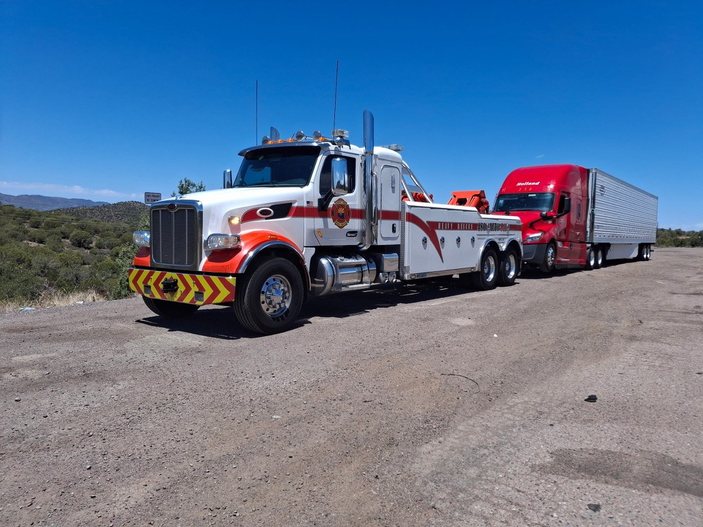
Location first: mile marker, direction, and what the road surface is doing. Tell dispatch the load status and whether you’re chained. Our Heavy Rescue crews run the high country all winter — chained wreckers, winching on ice, and honest ETAs for the drive time — as the winter recovery case study shows. Heavy dispatch: (480) AUTO-911, 24/7, from our Mesa base with statewide response.
For fleet managers
If your lanes cross Arizona in winter, put a recovery plan in the driver packet: az511 for closures, chain-up points, and one phone number that answers at 2 AM. A standing vendor agreement means our dispatch already knows your fleet, your billing, and your preferred shops before the first storm.
Need help right now?
Guides are for later — dispatch is for now. Live 24/7: (480) 577-5334 · heavy & commercial (480) AUTO-911